 Veterinary Falcon
Pet Clinic LLC
Get a quote
The crate is the part that gets people turned away
Paperwork fails weeks ahead, where it can be fixed. A crate fails at the check-in desk, two hours before a flight, with nothing to be done about it. This page is the actual rule — how to measure your animal, what the box has to be, and the handful of things that get a crate refused.
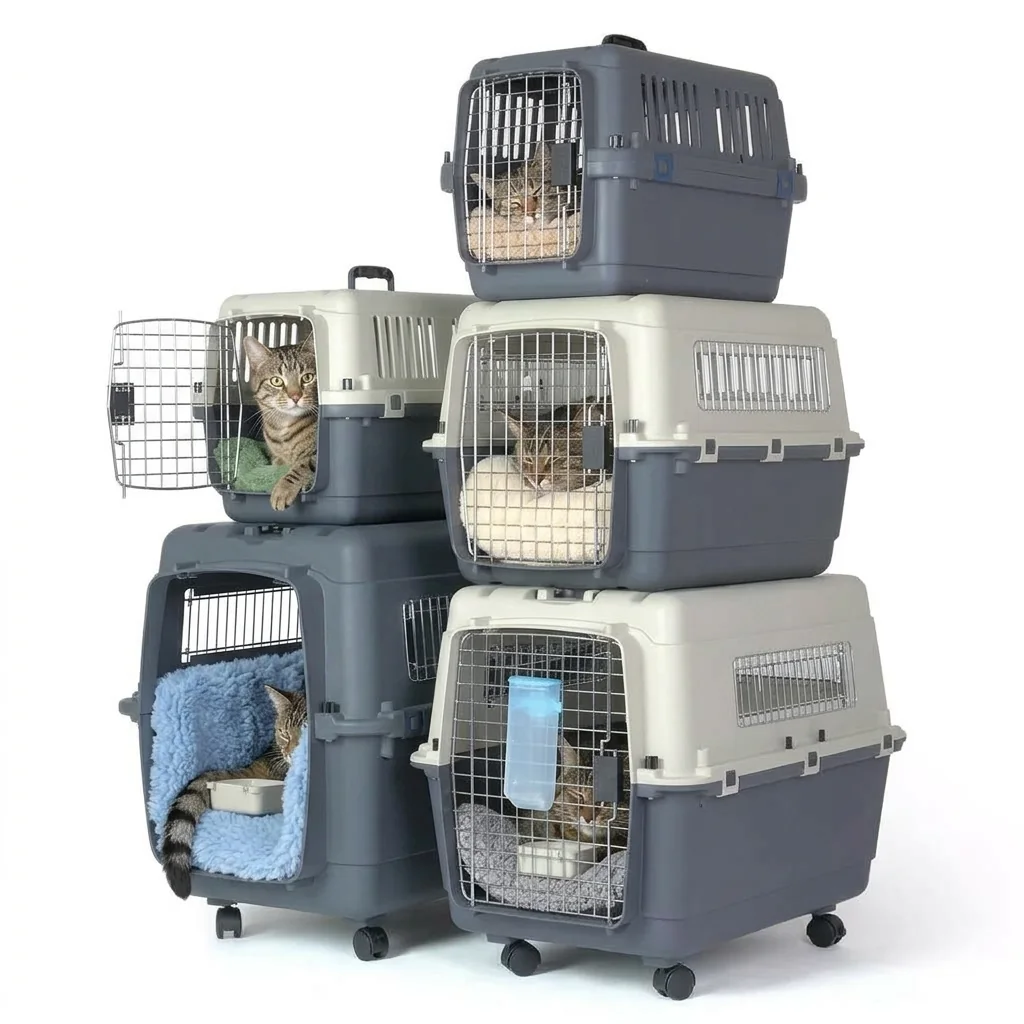
Four measurements, taken on a standing animal
Measure the animal, then size the box from the animal. Doing it the other way round — buying a crate and hoping — is how most of this goes wrong. If you are crating more than one, measure the largest.
Nose to tail base
Tip of the nose to the base of the tail, not the tip of it.
Ground to elbow
Floor to the elbow joint, with the animal standing.
Across the shoulders
The widest point, whether that is the shoulders or not.
Standing height
Floor to the top of the head — or the ear tip, if the ears are higher and stay up.
Two adjustments. A snub-nosed breed — pug, bulldog, Persian, Boxer, Shih Tzu — needs 10% added to the container size, and several airlines refuse them in the hold altogether. And the formula is a starting point, not the test: the animal must be able to stand, sit upright, lie down naturally and turn around. If it cannot, the box is too small whatever the arithmetic says.
What the box itself has to be
Straight from the IATA container requirement for dogs and cats. Airlines check against this and reject against it.
Structure
- Fibreglass, metal, rigid plastic, welded mesh, or solid wood at least 12 mm thick for dogs and 6 mm for cats
- A container made entirely of wire mesh is not permitted
- A solid, leak-proof floor and a solid roof
- Nothing inside the animal can bite or catch on
Door and fastenings
- The door forms one whole end, sliding or hinged
- Locking pins must engage the frame by at least 16 mm
- A plastic crate needs metal hinges and locking pins — plastic clips alone are refused
- Top and bottom halves bolted, with metal nuts and bolts through every hole
- Cable ties at the four corners of the door frame
Ventilation
- At least 16% of the total surface area of the four sides
- On all four sides, in the upper two thirds of the sides and back
- One entire end in welded wire mesh, fixed so the animal cannot push it out
- Openings no larger than 25 × 25 mm for dogs, 19 × 19 mm for cats, and nose- and paw-proof
Fittings
- Spacers along both long sides and the back, so freight cannot block the vents
- Handles the ground crew can actually lift by
- A water bowl fixed inside and fillable from the outside — a bottle or dispenser does not count
- Absorbent bedding
- Wheels removed or disabled
Labels
- A green Live Animals label — mandatory
- This Way Up arrows on at least two opposite sides
- The animal’s name on the box is recommended
- Your details and the consignee’s, attached to the outside
Why crates get turned away
None of these are unusual. Every one of them is something the handler checks in the thirty seconds before the crate is accepted.
Too small by the performance test
The arithmetic worked, but the animal cannot stand with its ears clear of the roof or turn around. The handler decides this by looking, not by measuring.
Plastic clips holding the halves together
The commonest failure of all. The crate came with plastic clips, nobody replaced them, and the airline wants metal bolts through every hole.
Wheels still on
They have to be removed or disabled. A crate that can roll is a crate that will.
Ventilation on three sides
Many retail crates vent the sides and back but not the door end, or only in the lower third. Sixteen per cent across all four sides is the rule.
No external water access
The bowl has to be refillable without opening the door. On a long transit somebody will need to do exactly that.
A snub-nosed breed in a standard-size box
Ten per cent more space is required, and some carriers will not take the breed in the hold at all, in any box.
When two can share, and when they cannot
- Puppies or kittens: up to three may share if they are weaned, under six months, no more than 14 kg each and used to one another.
- Adults: two may share if each is 14 kg or less, they are a similar size, and they already live together.
- Anything over 14 kg travels alone.
- Two animals in one box makes the box wider — C × 3 rather than C × 2 — which often costs more than two separate boxes, because airlines charge on volume.
Separately from the box: a female in heat, a female with unweaned young, a puppy or kitten under eight weeks, and an animal in the last third of pregnancy or within seven days of giving birth cannot be shipped at all. Routine sedation is not permitted either, and we will not prescribe it for a flight.
What people ask about crates
Can I buy a crate here or should I bring one?
Buy it here, and buy it before the flight is booked rather than after. We stock travel crates and we measure the animal against the box in the clinic, which is the only way to be sure the two match. The crates are on our accessories page.
How early should my pet live with the crate?
Weeks, not days. The box should be somewhere normal in the house with the door open and the animal’s bedding in it long before the journey. An animal that already sleeps in the crate travels completely differently from one that meets it at the airport.
Does the crate change what I pay the airline?
Yes, and often by more than the animal does. Airlines charge on the greater of actual weight and the volume the box occupies, so an oversized crate costs real money on every leg. How that is worked out is on the charges page.
My dog is a bulldog. Is there a problem?
Possibly a serious one. Snub-nosed breeds need ten per cent more crate, and a number of airlines will not carry them in the hold at any size because of the breathing risk. That is a conversation to have at the first appointment, not at booking.
Bring the animal in and we will measure it
Ten minutes with a tape measure settles the crate, and the crate settles the booking and most of the cost. We would rather do it now than at the desk.